

A quarter-century ago, Shawn Matheson found himself straddling two distinct realms.
While serving as a firefighter with Mississauga Fire and Emergency Services, he and his fellow firefighters watched in real-time as the twin towers in New York City crumbled, grasping the magnitude of the tragedy more acutely than many others.
As a reservist officer, Matheson had an instinctive understanding of the direction in which events were heading.
“Like anyone in the fire service, we were trying to comprehend what was happening and its implications,” Matheson expressed.
“My thoughts were oscillating between the sorrow of the live coverage I was witnessing… and my role as a soldier and what that entailed.”
This week, much like countless others, Matheson has been pondering the September 11, 2001 attacks that claimed nearly 3,000 lives, including 24 Canadians.
-
Trump, former U.S. presidents mark 25 years since 9/11 attacks at separate ceremonies
-
Jean Chrétien says ‘we bow to no one’ in fiery 9/11 speech in Gander, N.L.
His dual roles as firefighter and soldier have heightened his awareness of the dangers and sacrifices associated with service, which ultimately motivated him to volunteer with the mental health organization Wounded Warriors Canada.
On the day of the attacks, a segment of his fire station was dispatched to relieve firefighters at a station close to Pearson International Airport as U.S. airspace was being closed and planes were landing across Canada.
The attacks occurred on a Tuesday, coinciding with parade night for his reserve unit, the Governor General’s Horse Guards (GGHG).
He described the experience as surreal.
‘Those hours of the unknown’
“It was a uniquely strange day to don our uniforms, realizing that Canada might be heading to war,” Matheson remarked, having started his military career as a full-time armored soldier in the 1980s, serving in Bosnia before transitioning to a reservist and firefighter.
“In those uncertain hours, we pondered what could possibly come next.”
In the weeks following the attacks, Matheson joined fellow firefighters in New York to attend memorial services as remains were being unearthed from the debris.
“There are incredibly strong bonds within the fire community across various departments, not just in Canada but also in the United States,” he recalled. “Firefighters in Mississauga had friendships with those in the New York Fire Department and nearby departments. They used to compete in hockey tournaments together.”
While at Ground Zero, Matheson noted that the remains of six additional individuals were recovered.
The grief was tangible.
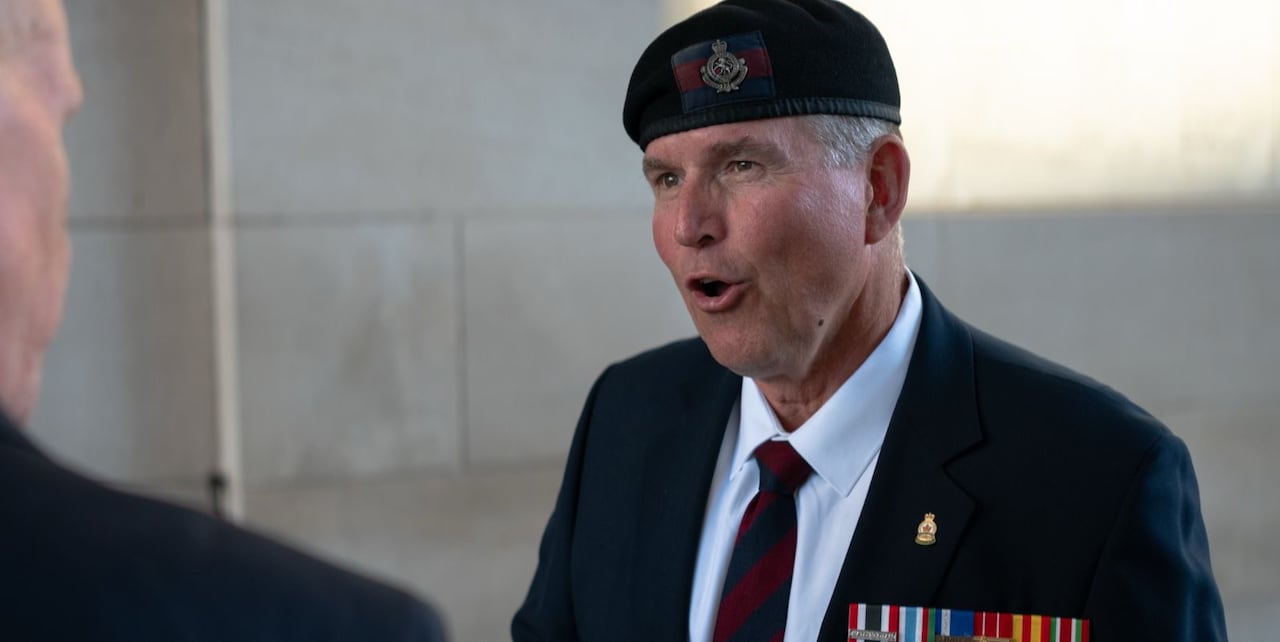
During the Afghan war, Matheson commanded the Governor General’s Horse Guards and watched as 14 of his soldiers were deployed overseas to fight. (Wounded Warrior Canada)
Subsequently, as Canada’s involvement in the Afghan war intensified and became more perilous, he took command of the GGHG and observed as 14 soldiers from his unit were deployed to support regular forces engaged in Kandahar.
Fortunately, he reported, they all came back safely.
As the 25th anniversary of 9/11 approached, Matheson participated in a Wounded Warriors fundraising bike ride through Canadian First World War battlefields in Belgium.
He found himself reflecting on the advancements in support services for both military personnel and first responders since the tragic events of two and a half decades ago.
Acknowledgment of the psychological impacts on first responders from the traumatic incidents they encounter, Matheson noted, is something that was long overdue.
For Matheson, this realization encapsulates the lesson of 9/11.
“They are frequently exposed to significant trauma,” Matheson stated. “The individuals in fire trucks, police vehicles, and ambulances are facing their own battles daily. They cannot predict the outcome of their shifts and whether they will return home safely.”