

The news that Nvidia’s CEO, Jensen Huang, engaged in an affair with a former executive from a Singaporean firm has sparked worries regarding China’s access to high-end microchips that have been restricted from the nation.
Huang has acknowledged his relationship with Alice Huang, a Chinese businesswoman who subsequently became the majority shareholder of Megaspeed International, a cloud-computing enterprise based in Singapore.
According to The New York Times, U.S. officials recently concluded that she was a Chinese intelligence agent who relayed information to Beijing while maintaining a close connection with the Nvidia CEO — a claim that China’s Foreign Ministry has dismissed as “baseless.”
Additionally, Megaspeed has come under the radar of U.S. regulators due to concerns that it may have facilitated the acquisition of advanced Nvidia chips by Chinese firms, which are subject to export prohibitions from Washington.
This scandal has highlighted the effectiveness of U.S. restrictions on advanced chip exports to China.
Let’s explore why China is in need of these superior chips, the reasons behind the U.S. export ban, and the ways in which China continues to obtain them.
Why does China want Nvidia’s chips?
Nvidia is known for designing some of the world’s most potent AI chips, which are regarded as the benchmark in the industry, according to analysts.
“Their chips lead the AI revolution,” stated Ryan Ellis, an associate professor at Northeastern University in Boston, specializing in communication law, policy, and cybersecurity.
According to Dennis Wilder, a former senior U.S. intelligence officer and director for China at the National Security Council, artificial intelligence requires extensive graphics processing unit (GPU) capabilities.
High-performance chips from Nvidia offer a cost-effective strategy for developing AI without necessitating the establishment of additional data centers for increased GPU capacity, Wilder mentioned.
These chips also enable the most sophisticated AI models, Ellis added, indicating that restricted access to them could hinder progress.
<p"There is an immense demand for these chips within China," he noted. "A vibrant black market for the latest video chips exists in the country."
Why did the U.S. prohibit sales of these chips to China?
In October 2022, the U.S. Department of Commerce, under the Biden administration, imposed export controls on advanced computing chips destined for China. This means Nvidia’s high-end chips, Blackwell Ultra and Vera Rubin — both GPUs utilized for AI applications—are prohibited from being sold to the country.
The U.S. government cites two primary reasons for these sales bans: to uphold the nation’s leading position in AI development and to safeguard national security.
Whoever excels in the AI race and can train the most effective models will likely dominate in this next phase of the AI evolution, explained Chris Mattmann, the inaugural chief data and AI officer at UCLA.

Nvidia shares took a significant hit following the investigation launched by the U.S. tech giant into CEO Jensen Huang’s affair with a woman whom U.S. intelligence agencies allege is a spy for Beijing.
Despite the current lead of the U.S. over China, that gap is narrowing, according to Mattmann. Any factor that could “tip the scales,” such as access to advanced chips, assists in closing this divide.
Furthermore, the U.S. government aims to ensure national security, fearing that granting China access to such chips could enhance its military capabilities and potentially lead to systems that might jeopardize U.S. interests.
“Export controls are always about balancing market growth while ensuring that national security is not compromised,” Ellis noted.
However, former President Donald Trump has relaxed some restrictions, permitting the sale of certain Nvidia chips — typically those intended for consumer electronics — to China under specific circumstances.
How is China acquiring Nvidia chips?
Shortly after the advanced chip restrictions on China were established, numerous vendors initiated an illegal smuggling and underground network to deliver these chips into China for sale to local companies, as reported by Germany’s Deutsche Welle (DW) news agency.
The U.S. has been cracking down on those vendors whenever feasible. In December 2025, the Department of Justice announced the apprehension of two Chinese individuals for allegedly smuggling Nvidia chips to China.

A screenshot from CTI video footage shows a woman identified by Reuters as Alice Huang, attending a dinner with Nvidia CEO Jensen Huang at a Taipei restaurant on May 22, 2025. (Reuters)
Additionally, there exists a legal loophole that can be exploited to transfer chips to China.
While Nvidia is prohibited from selling its most advanced chips directly to China or its companies, it can sell them to other nations, allowing third-party data centers to lease access to those centers to Chinese-affiliated companies.
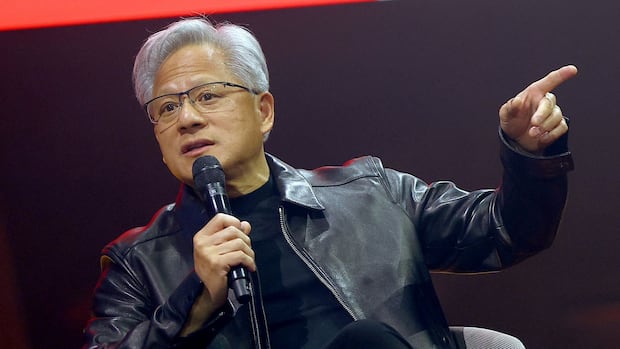
Nvidia is conducting an investigation into CEO Jensen Huang following his admission of an affair. The woman involved is accused of being a Chinese spy, allegedly passing information to Beijing, as indicated in a media report. Julian E. Barnes of The New York Times, who first reported the story, noted that ‘there is still much to uncover in this narrative.’
For instance, Nvidia might sell its chips to a Malaysian company, which would then lease that computing power to a Chinese firm, Ellis explained, stating that “this would be legitimate.”
While certain U.S. lawmakers argue that this loophole should be closed, others contend that it is a reasonable adjustment, according to Ellis.
However, he indicated that the ongoing scandal implies that these chips are often sold to other nations, only to be subsequently smuggled directly into China.
Are the export controls really effective?
Ellis remarked that U.S. export controls “will never be completely foolproof.”
Nevertheless, he suggested that there should be more random inspections and stricter oversight to ensure that the chip purchasers are indeed the end users. “The enforcement is lacking.”
The enforcement division of the U.S. Commerce Department, the Bureau of Industry and Security, is not adequately staffed to implement the restrictions, Wilder concurred.
For example, Reuters reported that China’s Northwestern Polytechnical University procured Nvidia H200 chips last month, as per official records. Furthermore, the agency discovered that various Chinese universities have acquired Nvidia chips that are restricted from export, including many institutions closely tied to China’s defense sector or military research.
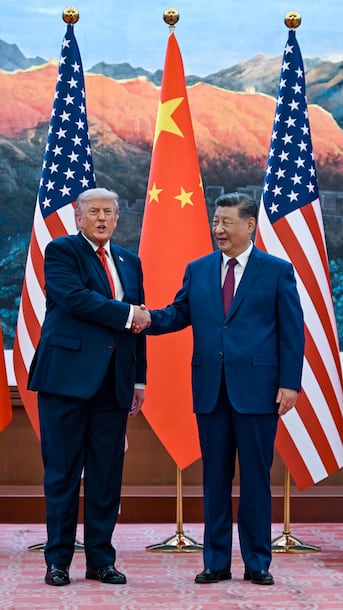
The rise of AI agents functioning independently of human guidance has led Washington to propose an emergency communication line with Beijing. Andrew Chang explains the rationale behind the U.S. decision to maintain an open dialogue on AI despite a backdrop of rivalry and distrust.
The export controls have also raised doubts about their effectiveness in hindering Chinese advancements.
Since the U.S. barred Huawei — and subsequently China — from acquiring some of the most powerful computing chips and chip manufacturing equipment in 2019, Chinese semiconductor manufacturers have been racing to achieve self-sufficiency, focusing on developing their own chips and technological expertise.
Jensen Huang, who has advocated for more lenient export regulations on China, argues that ongoing U.S. sales to China would sustain American technological dominance and keep Chinese customers dependent on U.S. innovations.
“We need to ensure national security and protect our nation, but we should also compete and expand our tech industry and maximize our exports,” the Nvidia CEO stated to The Associated Press in June.