

Prime Minister Mark Carney has announced Canada’s intention to initiate talks regarding a “unique alliance” with the European Union, clarifying that this does not involve seeking membership, as he prepares to speak before the European Parliament this week.
“Our goal is not to pursue membership in the European Union,” Carney stated on Sunday evening while attending the Toronto International Film Festival. His appearance at the festival followed a speech at the Canada Investment Summit, which commences on Monday.
“What we aim to establish — and what discussions will begin — is a unique alliance with the European Union. We share common values, align on priorities, and possess complementary strengths.”
These remarks were made following a report from the Wall Street Journal on Saturday, which indicated Carney’s efforts to strengthen Canada’s ties with the 27-nation European bloc, instructing his team to explore the most ambitious options that fall short of full membership.
The Journal also noted that Carney had proposed the idea of Canada adopting the designation of “associate member.”
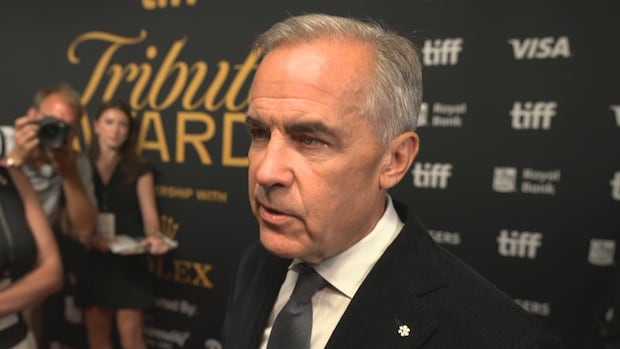
Prime Minister Mark Carney was questioned on the TIFF red carpet about a report from the Wall Street Journal that speculated on Canada potentially becoming an ‘associate member’ of the EU. He reiterated that Canada intends to pursue a ‘unique alliance’ with the European bloc without seeking membership.
This report prompted a strong rebuttal from Conservative Leader Pierre Poilievre, who expressed on social media on Sunday evening that Carney is “completely out of touch.”
“We will NEVER be the 51st U.S. state,” Poilievre asserted. “And we will NEVER become the 28th EU state.”
A senior Canadian official, who spoke to CBC on a not-for-attribution basis, mentioned that there have been ongoing discussions about enhancing Canada’s relationship with Europe to promote greater sovereignty for the nation.
The official clarified that Canada is not willing to sacrifice its independence for access, emphasizing that the federal government is more focused on the outcomes of strengthened ties rather than the terminology used.
The notion of the “associate member” designation is one of several options under consideration, and Canada did not initiate it. The official added that the government is still exploring what the relationship might entail and aims to provide a clearer outline at the EU-Canada summit scheduled for the end of October.
Canada, the EU and the U.S.
Recently, members of the cabinet have voiced their support for Canada strengthening ties with Europe as a means to reduce the nation’s economic reliance on the United States.
“I believe Canadians should feel reassured that we are pursuing partnerships in a market that is essentially larger than the U.S. consumer market,” Finance Minister François-Philippe Champagne told CBC’s The House on Friday.
Canada and the U.S. are currently engaged in a contentious trade conflict, with Canada implementing $27.6 billion in counter-tariffs earlier this week. In response, the United States announced it would prohibit the importation of Canadian alcohol, motorcycles, and additional products starting September 29.
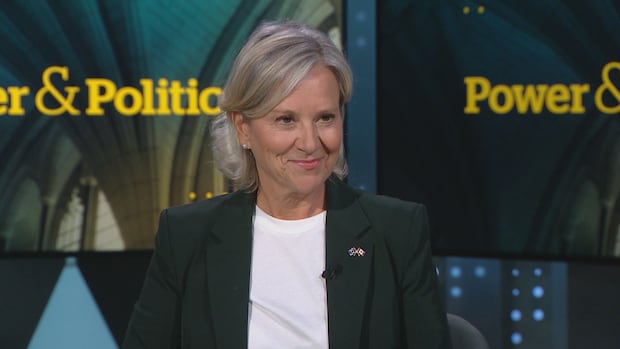
Power & Politics engages with the EU Ambassador to Canada Geneviève Tuts as Prime Minister Mark Carney prepares to address the EU Parliament next week. Tuts emphasizes the growing relevance of strengthening Canada-EU relationships in light of recent actions by U.S. President Donald Trump.
In a discussion with Power & Politics earlier this week, EU Ambassador to Canada Geneviève Tuts mentioned that the two parties already collaborate effectively but are eager to “advance beyond that.”
“Not merely a new partnership, but something distinct and, in a sense, unique,” Tuts stated. “We aspire to reimagine the relationship between the EU and Canada.”
Carney is scheduled to travel to Strasbourg, France, on Tuesday and will present his address to the European Parliament on Thursday, following an invitation from President Roberta Metsola.
Canada is also set to host the EU summit on October 29 and 30.